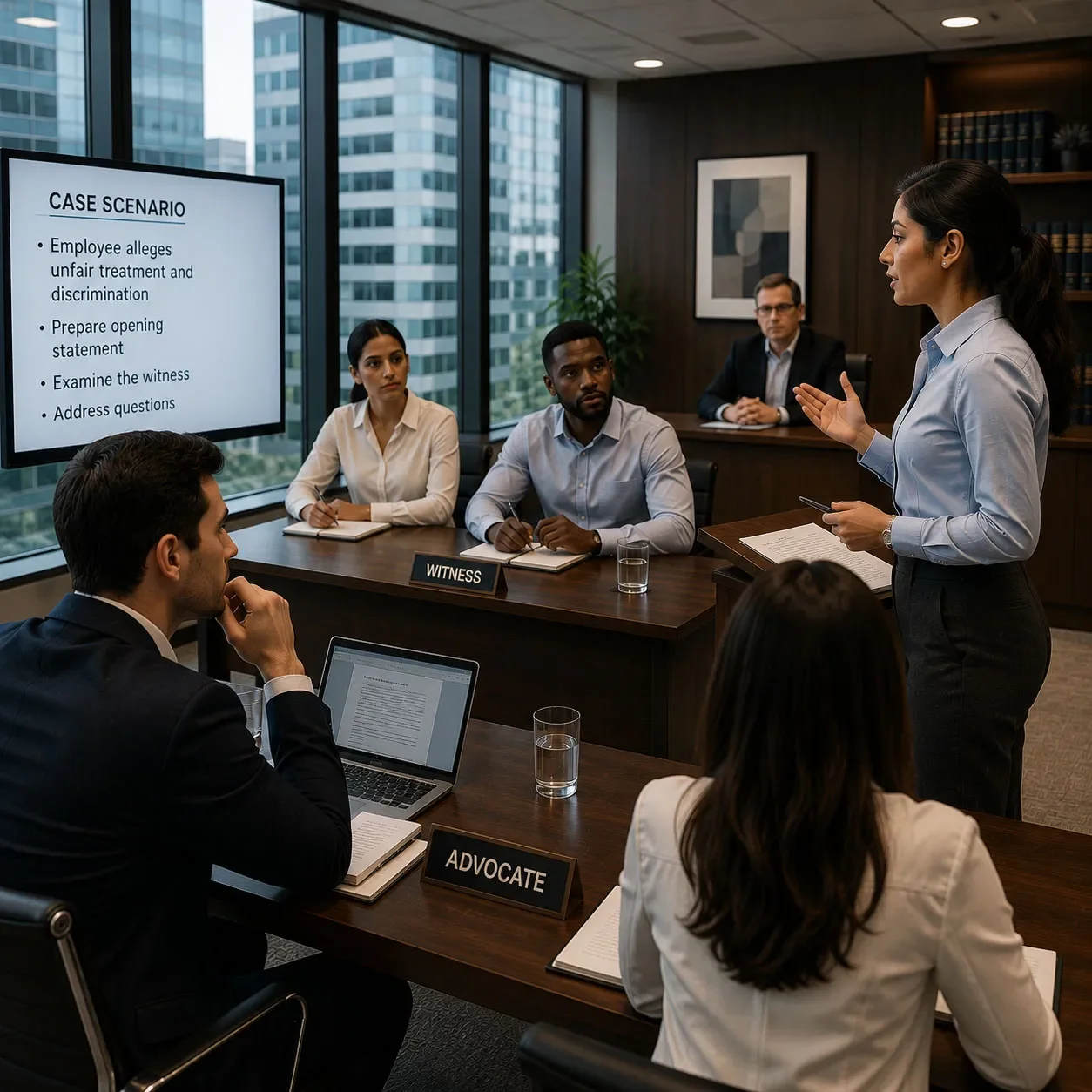
Advocates don’t improve by watching
Effective advocacy is developed through practice. While lectures and discussion can introduce concepts, advocates improve most when they are required to make decisions, respond to pressure, and communicate in real time.
Going AWOL emphasizes experiential learning. Our programs move beyond discussion and give participants the opportunity to practice advocacy skills in realistic, structured settings.
Built through practice. Ready for the real world.

Custom-designed simulations
Because our simulations are custom-designed, we can focus on the issues most relevant to your organization. Whether the goal is to strengthen arbitration advocacy, improve communication, or address recurring challenges, we can develop exercises that reflect your specific context.
Presenting a grievance
Responding to witnesses
Decisions under uncertainty
Difficult expectations
How a session unfolds
We develop simulations tailored to the needs of the organization and the challenges participants are likely to face. Each exercise is built around a specific scenario drawn from common workplace situations in labor relations.

Role-Based Structure
Each simulation is structured around distinct roles.
Hover To View DetailsRole-Based Structure
Our simulations are structured around distinct roles, typically including:
- Advocate
- Client representative
- Counterpart or opposing participant
- Observer
Each role receives different information and objectives, mirroring real-world advocacy where participants must operate with incomplete information and respond to the actions of others.
The observer role plays an important part in the learning process by focusing on specific behaviors and providing structured feedback.

Realistic Constraints
Exercises reflect the realities of labor relations practice.
Hover To View DetailsRealistic Constraints
Exercises reflect the realities of labor relations practice, including:
- Limited preparation time
- Incomplete or disputed facts
- Time-boxed hearings
- Difficult or evasive witnesses
Participants make decisions under pressure and adapt as the exercise unfolds, just as they would in an actual hearing.

Structured Feedback & Debrief
Exercise ends with a structured debrief to reflect and learn.
Hover To View DetailsStructured Feedback & Debrief
Each exercise ends with a structured debrief designed to turn practice into lasting skill:
- What worked and why
- Missed opportunities
- Specific, behavior-focused feedback
- Concrete next steps
Debriefs draw on observations from the session, so feedback is grounded in what actually happened, not general advice.

What participants gain
Experiential training helps participants develop the capabilities that define effective advocacy in labor arbitration and labor relations more broadly. Participants practice working through realistic situations that require preparation, judgment, and effective communication.
Through hands-on exercises and structured feedback, participants strengthen their ability to prepare cases, assess facts, question witnesses, present evidence, and make sound decisions under the pressure of a live hearing.
Key Capabilities
Case preparation
Questioning witnesses
Evidence and law
Post-hearing briefs

Built around your organization
Because our simulations are custom-designed, we focus on the issues most relevant to your organization — developing exercises that reflect your specific context and the challenges your people actually face
Problems tailored to your industry: manufacturing, transportation, police, fire, education, etc.
Problems tailored to your specific CBA.
Problems based on recurring situations that you identify as troublesome.